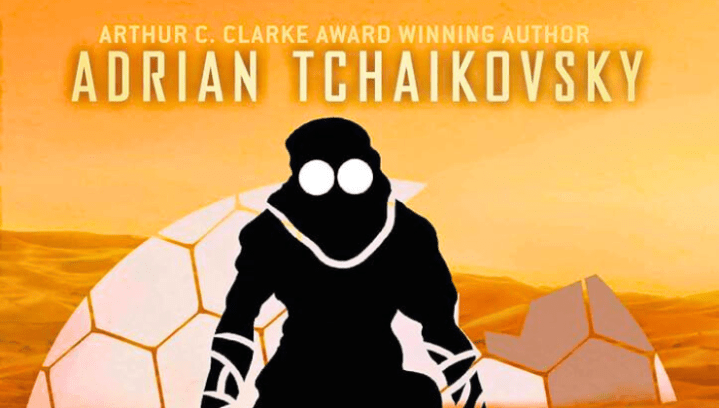
Firewalkers, by Adrian Tchaikovsky, is a brutal meditation on class division and climate change.
The mega rich are escaping a barren, parched Earth into opulent space liners with every amenity. The novel is centred on a liner named the Grand Celeste. The wealthy – or sonko – wait their turn to ascend in antebellum hotels. These are staffed by middle class workers who delusionally hope for their spot in heaven. And working class people living in crammed townships, like Ankara.
Firewalkers are working people who maintain the infrastructure of the luxury space ports.
Synopsis
FIREWALKERS ARE BRAVE
FIREWALKERS ARE RESOURCEFUL
FIREWALKERS ARE EXPENDABLE
The Earth is burning. Nothing can survive at the Anchor; not without water and power. But the ultra-rich, waiting for their ride off the dying Earth? They can buy water. And thanks to their investment, the sun can provide power.
But someone has to repair the solar panels when they fail, down in the deserts below.
Kids like Mao, and Lupé, and Hotep; kids with brains and guts but no hope.
The Novel

The novel centres on three teenage Firewalkers, and their lucrative mission to discover what is draining the power from the local grid. The mission is extremely risky; easily earning ‘double-triple’ danger pay.
Firewalkers are young; they don’t get old.
The team comprises Mao, a Vietnamese refugee who is the leader and muscle of the group. Lupé, a local and genius engineer. And Hotep, their hacker, who was born on the luxurious Grand Celeste, and is consumed with bitterness over being cast out.
Their journey takes them across a perilous wasteland, encountering danger, illusion and temptation.
Characters

Hotep is strongly implied to be both neurodivergent and mentally ill. She tried, and tried and tried, but was unable to conform to the social requirements of the global elite. The fact that her wealthy parents were willing to cast her out, thereby condemning her to a short, brutal life – likely to end in either starvation or cancer – is a chilling moral event horizon.
<span class=”spoiler“>It is also interesting to me that ultimately, Hotep – neurodivergent, mentally ill, and objectively wronged – cannot bear to pull the trigger on the upper classes. It is the intelligent, stable and practical Lupé who ‘makes a deal with the devil’ to obliterate the elite. And she only does so when given no other possible choice for survival.</span>
There is also a disturbing passage at the end of the book, where their benefactor offers Mao something he’s always wanted.
I would argue that the protagonists made the only moral choices in front of them. All three are extremely sympathetic. However the last interaction with Mao reframes the benefits the other two received as tailored bribes.
<span class=”spoiler“>Hotep was able to return to the stars without getting her hands dirty. Mao got the girl of his dreams. And Lupé, the consummate troubleshooter, got to fix the ultimate, key problem in her society – albeit at the cost of making the hard choices.</span>
In the End

“Those vastly wealthy men said that AIs might seize control of the world and do what they wanted, heedless of the needs, safety or rights of the run of humanity.”
“Sounds like you’ve got it down.”
“Didn’t it ever occur to you that they were describing themselves?”
I would highly recommend this novel. It’s difficult to go into too much detail without spoiling the story but I absolutely loved it. I particularly appreciated the creeping sense of unreality and horror within the rippling, overheated landscapes. It has hints of <span class=”spoiler“> Mad Max movies, Tank Girl comics, Dune even, a little. I really enjoyed this short novel. </span>
 COPPER LANTERN BOOK REVIEWS